

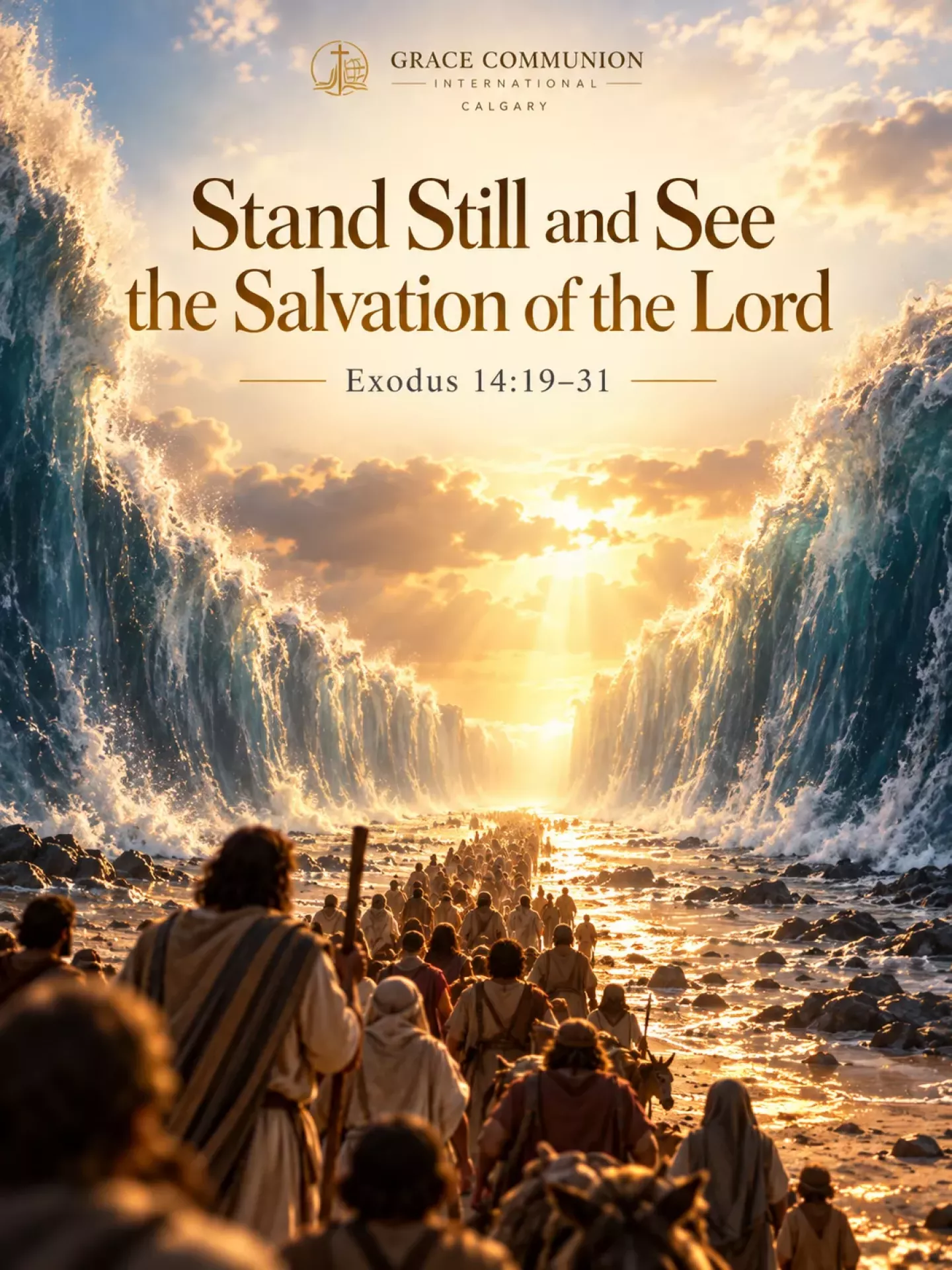
Exodus 14:19–31
Introduction
There are moments in life when we find ourselves standing between what is behind us and what is in front of us.
Behind Israel was Pharaoh’s army. In front of them was the Red Sea. On either side was wilderness. Humanly speaking, there was nowhere to go.
The Israelites had just experienced the mighty hand of God in Egypt. They had seen the plagues. They had witnessed God’s judgment against Egypt’s gods. They had celebrated the first Passover. They had walked out of slavery as free people.
But freedom did not mean that they would never face another crisis.
Exodus 14 brings them to one of the greatest crises of their journey. Pharaoh changed his mind and pursued Israel with his army, horses, and chariots. The Israelites suddenly found themselves trapped. The situation appeared impossible.
They could not defeat Pharaoh’s army. They could not cross the sea. They could not return to Egypt without returning to slavery.
Yet what looked like a dead end to Israel became the stage upon which God revealed His glory.
Earlier in the chapter, Moses told the people:
“Do not be afraid. Stand firm and you will see the deliverance the LORD will bring you today... The LORD will fight for you; you need only to be still.”
— Exodus 14:13–14
That declaration prepares us for verses 19–31.
Israel was about to discover that when we cannot see a way forward, God is not limited by what we can see.
The sea was not an obstacle to God. Pharaoh’s army was not too powerful for God. Israel’s fear did not cancel God’s faithfulness. The apparent dead end was not the end of their story.
Exodus 14:19–31 reveals three powerful truths for God’s people:
- God’s presence protects us.
- God’s power makes a way for us.
- God’s victory leads us into deeper faith.
1. God’s Presence Protects His People
Exodus 14:19–20
The angel of God who had been traveling in front of Israel moved behind them. The pillar of cloud also moved from the front of the people to the rear.
This movement is significant.
The presence that had been leading them now became the presence that was protecting them. God placed Himself between His people and their enemy.
The same cloud had two different effects. To the Egyptians, it brought darkness. To Israel, it brought light.
God had not abandoned Israel in the crisis. He had repositioned His presence according to what His people needed at that moment.
Sometimes we recognize God when He is leading us forward. But Exodus 14 teaches us to recognize God when He stands behind us and protects us from what is pursuing us.
Israel could probably hear Pharaoh’s army approaching. They could see the sea in front of them. They knew they were vulnerable.
But between Israel and Pharaoh stood the presence of God.
Their security was not found in their military strength. Their security was found in who stood between them and the enemy.
Psalm 46:1–2
“God is our refuge and strength, an ever-present help in trouble. Therefore we will not fear, though the earth give way and the mountains fall into the heart of the sea.”
Notice that Scripture does not say God’s people will never experience trouble. It says God is “an ever-present help in trouble.”
Our confidence is not that trouble will never come.
Our confidence is that when trouble comes, God is present.
Isaiah 43:2
“When you pass through the waters, I will be with you; and when you pass through the rivers, they will not sweep over you.”
God does not always promise to keep us from the waters. Sometimes He promises to meet us in the waters.
Notice the word “when.”
“When you pass through the waters...”
There will be difficult seasons. There will be moments when we do not know what will happen next. But God’s promise remains:
“I will be with you.”
Illustration: The Parent at the Road
Imagine a small child walking beside a busy road with a parent.
The child may hear trucks passing. The child may see vehicles moving quickly. The child may not understand traffic patterns or recognize every danger.
But the parent does.
So the parent instinctively positions himself between the child and the traffic. The child may not even realize how much protection is taking place.
That is a picture of what happens in Exodus 14.
Israel saw Pharaoh. Israel saw the sea. Israel saw danger.
But God saw everything they could not see, and His presence moved between them and their enemy.
There are times when we may not recognize how many things God has protected us from. We see the problems that reached us, but we do not see all the things God prevented from reaching us.
Perhaps something is pursuing you today.
It may be fear about your future. It may be the consequences of your past. It may be financial pressure, family difficulty, uncertainty, opposition, or disappointment.
Do not measure God’s presence only by whether the problem has disappeared.
The Israelites still had a sea in front of them when God moved behind them. God was already working before the sea opened.
Before God changed their circumstances, He secured His people with His presence.
When you cannot yet see the way forward, remember: God is still present.
2. God Makes a Way Where There Is No Way
Exodus 14:21–25
Then Moses stretched out his hand over the sea. God sent a strong east wind throughout the night. The waters divided, and Israel walked through the sea on dry ground.
Think about what Israel witnessed.
What had looked like an impossible barrier suddenly became a pathway.
The sea that seemed to say, “You cannot go any farther,” became the very place through which God led them into freedom.
This is one of the great patterns of Scripture:
What is impossible for us is not impossible for God.
Israel did not build a bridge. Israel did not find boats. Israel did not defeat Pharaoh. Israel could not manufacture its own deliverance.
God made the way.
Notice that Exodus says God worked “all that night.” There was a process occurring while Israel waited.
Sometimes God’s work happens where we cannot immediately see it.
We may be praying while God is working.
We may be waiting while God is working.
We may be wondering while God is working.
We may think nothing is happening because the answer has not appeared yet. But the Red Sea reminds us:
God can be working through the night before we see the pathway in the morning.
Isaiah 43:16, 19
“This is what the LORD says—He who made a way through the sea, a path through the mighty waters... See, I am doing a new thing!... I am making a way in the wilderness and streams in the wasteland.”
The God who made a way through the Red Sea is the God who says:
“I am making a way.”
Where we see wilderness, God can see a highway. Where we see wasteland, God can produce streams. Where we see impossibility, God sees an opportunity to reveal His glory.
Luke 18:27
“What is impossible with man is possible with God.”
Our limitations are not God’s limitations.
Our resources may run out. Our wisdom may run out. Our strength may run out. Our options may run out.
But God does not run out.
Illustration: A Road Through the Mountain
Imagine travelers approaching an enormous mountain. From a distance, the mountain seems to completely block the road.
The travelers may think:
“There is no way through.”
But as they continue forward, they discover a tunnel.
The mountain has not disappeared. A way has been made through it.
Often we pray, “Lord, remove the mountain.” Sometimes God does. But sometimes God demonstrates His power by making a way through the very thing we thought would stop us.
Israel’s sea did not disappear. God opened a pathway through it.
The obstacle became the road.
Maybe you are standing before your own “Red Sea.” You have prayed, but you cannot see the answer. You have tried everything you know, but the situation still appears impossible.
Exodus 14 teaches us that God does not need an existing road in order to lead us forward.
He can create one.
But Israel still had to walk.
When God opened the sea, the people had to step onto the path. Faith is not only believing that God can make a way. Faith is walking through the way God provides.
Some doors God opens require courage to walk through. Some prayers God answers require obedience from us. Some new seasons require us to leave the old season behind.
When God says, “Go forward,” do not remain on the shore simply because the path is unfamiliar.
The God who opens the way is the God who will accompany you through it.
3. God Should Lead Us to Deeper Faith
Exodus 14:26–31
After Israel crossed safely, God told Moses to stretch his hand over the sea again. The waters returned. Pharaoh’s army was overwhelmed. The enemy that had terrified Israel was defeated.
Then Exodus 14:30 gives us this declaration:
“That day the LORD saved Israel from the hands of the Egyptians.”
Notice who received the credit.
The LORD saved Israel.
Verse 31 tells us the people’s response: when Israel saw God’s mighty hand displayed against Egypt, they feared the Lord and put their trust in Him and in Moses His servant.
God’s deliverance produced reverence and faith.
This is important because God’s blessings are not merely intended to make our lives easier. They are intended to help us know Him more deeply.
Every answered prayer should deepen our worship. Every deliverance should strengthen our faith. Every testimony should remind us of the character of God.
Israel entered the Red Sea afraid. Israel came out of the Red Sea with a new understanding of God’s power.
The circumstance had changed, but more importantly, the people were supposed to change.
Psalm 77:11–14
“I will remember the deeds of the LORD; yes, I will remember Your miracles of long ago. I will consider all Your works and meditate on all Your mighty deeds. Your ways, God, are holy. What god is as great as our God? You are the God who performs miracles.”
Remembering God’s past faithfulness gives strength for present difficulties.
Sometimes when we face a new Red Sea, we forget the old Red Seas God has already brought us through.
David remembered the lion and the bear before facing Goliath. Israel needed to remember Egypt when facing future challenges. We need to remember what God has already done when the next difficulty appears.
Romans 8:37
“No, in all these things we are more than conquerors through Him who loved us.”
Notice that Paul says “in all these things,” not “away from all these things.”
Christian victory does not mean believers never experience difficulty. It means difficulty does not have the final word.
Our victory is ultimately rooted in Jesus Christ.
At the Red Sea, God delivered Israel from Pharaoh’s power. At the cross and resurrection, Christ accomplished the greater deliverance—from sin and death.
The Red Sea therefore points us toward the larger biblical story of redemption:
God is a saving God.
Illustration: The Stone of Remembrance
Imagine someone who has walked through an extremely difficult season and keeps a small object on a desk—not because the object itself has power, but because it reminds them of what God did.
Years later, another crisis comes. They look at that reminder and say:
“God was faithful then. God is still faithful now.”
That is what testimonies do. They become landmarks of grace.
Yesterday’s deliverance becomes today’s encouragement. Today’s deliverance can become tomorrow’s testimony.
Do not waste your Red Sea experience.
When God brings you through something, remember it. Tell your children. Tell your family. Encourage another believer. Write it down. Give God the glory.
One day you may face another situation where fear says:
“This time you will not make it.”
Your testimony can answer:
“I have seen the faithfulness of God before.”
Conclusion
Exodus 14 begins with Israel trapped between an army and a sea. But it ends with Israel standing safely on the other side.
What changed?
God intervened.
The Israelites could not save themselves. But God protected them with His presence. God opened the sea with His power. God defeated their enemy. God brought His people safely through.
That gives us three truths to carry with us.
Trust God’s Presence
When you cannot see the way, trust God’s presence.
The cloud may move from before you to behind you. God’s activity may look different from what you expected. But a change in what God is doing does not mean an absence of God.
Sometimes He leads. Sometimes He shields. Sometimes He opens doors. Sometimes He closes doors.
But He remains faithful.
Trust God’s Power
When the situation looks impossible, trust God’s power.
The sea may be too deep for you. The army may be too strong for you. The problem may be too complicated for you.
But it is not too difficult for God.
The question is not:
“Can I handle this?”
The greater question is:
“Can I trust the God who holds me?”
Your strength has limits. God’s power does not.
Your wisdom has limits. God’s wisdom does not.
Your resources have limits. God’s resources do not.
Let His Faithfulness Deepen Your Faith
When God brings you through, let His faithfulness deepen your faith.
Do not simply celebrate the blessing and forget the Blesser. Do not simply enjoy the open sea and forget the God who opened it.
Let every answered prayer lead to worship. Let every deliverance lead to greater trust. Let every testimony prepare you for the next challenge.
The Gospel in the Red Sea
There is also a greater message in this passage.
Israel needed deliverance from slavery, and God provided it. Humanity needs deliverance from the slavery of sin, and God has provided that deliverance through Jesus Christ.
Just as Israel could not save itself from Pharaoh, we cannot save ourselves from sin.
Jesus died for our sins and rose again.
The cross looked like defeat, just as the Red Sea looked like a dead end. But what appeared to be defeat became God’s instrument of victory.
The resurrection declares that sin does not have the final word. Death does not have the final word. Fear does not have the final word.
God has the final word.
Perhaps today you are standing on the edge of a Red Sea. Inside you may be the question:
“Lord, what am I going to do?”
Remember Exodus 14.
You do not have to know how God will open the sea in order to trust the One who can open it. You do not have to understand the entire journey before taking the next obedient step.
The message of Exodus 14 is that the Lord saves, the Lord fights for His people, and the Lord is worthy of our trust.
The sea in front of you may look impossible, but the God who goes with you is greater than the sea.
Stand firm. Trust God. And when He opens the way, walk forward in faith.


Comments