

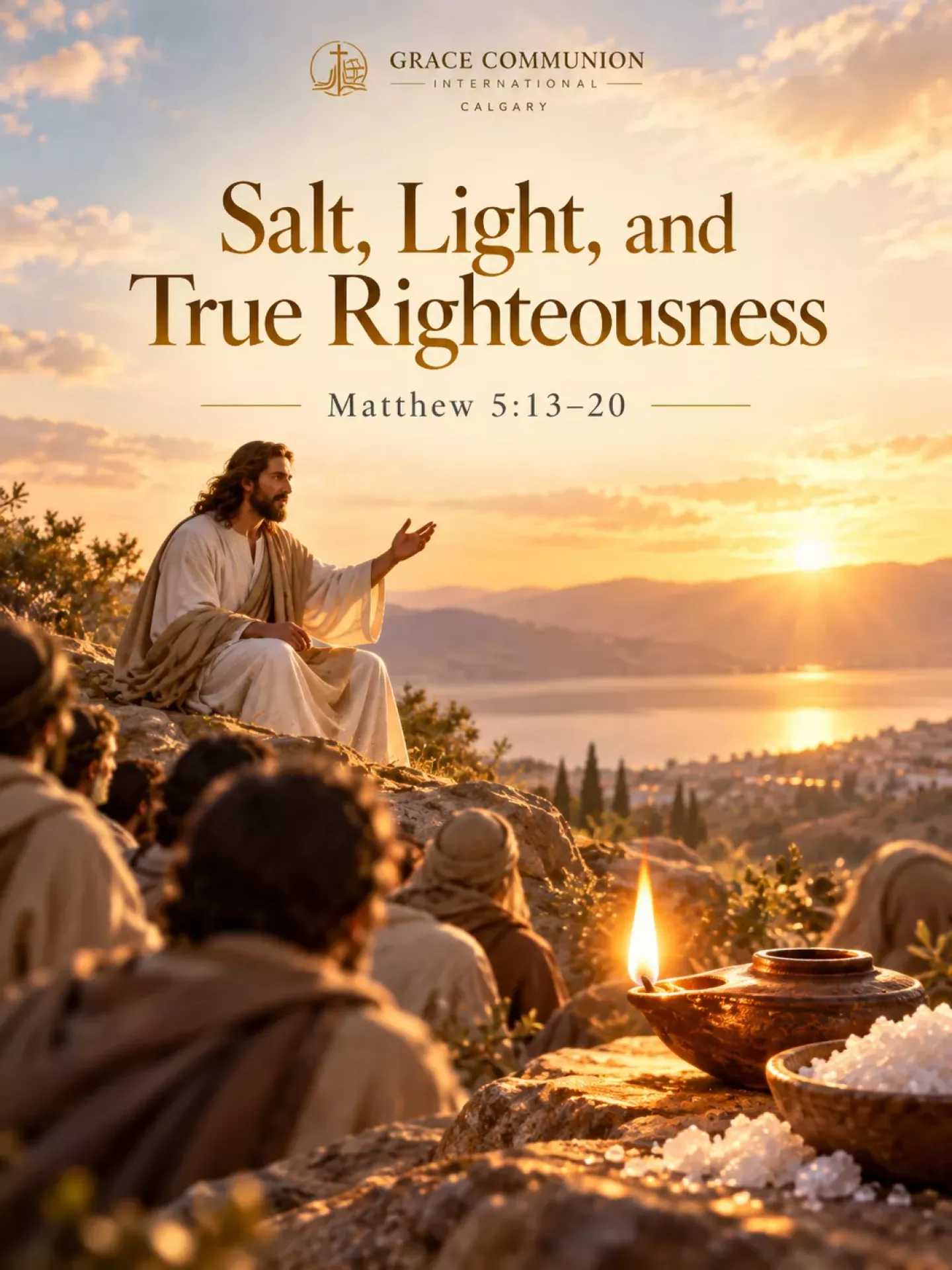
Matthew 5:13–20
Introduction
Matthew 5:13–20 is part of Jesus’ powerful Sermon on the Mount, one of the most important teachings in the entire Bible.
After declaring the blessings of those who belong to God’s kingdom in the Beatitudes, Jesus begins to describe how kingdom citizens should live in the world. He shifts from describing their character to explaining their mission and influence.
Jesus does not tell His followers what they might become someday; He tells them who they already are:
Salt of the earth and light of the world.
These are not suggestions but declarations of identity. If we truly belong to Christ, our lives must make a difference.
At the time Jesus spoke these words, His disciples were ordinary people—fishermen, tax collectors, and common workers. They had no political power, wealth, or social status. Yet Jesus declared that through them, God would impact the entire world.
This shows us that influence in God’s kingdom does not depend on position but on transformation.
Today, we live in a world filled with confusion, moral decline, and spiritual darkness. Many people are searching for hope, truth, and direction.
Jesus’ message remains the same: His followers are called to stand out, not blend in. We are called to influence, not isolate. We are called to reflect His righteousness in a world that desperately needs Him.
This passage challenges us to examine our lives:
- Are we truly living as salt and light?
- Are we reflecting Christ in our daily actions?
- Does our righteousness come from a genuine relationship with Him or merely from outward religion?
1. You Are the Salt of the Earth
Matthew 5:13
Jesus declares:
“You are the salt of the earth.”
This statement reveals both our identity and responsibility as followers of Christ.
In the ancient world, salt was extremely valuable. It was used for preservation, flavor, and purification. When Jesus calls us salt, He is showing that believers are meant to influence the world in a powerful and positive way.
Salt Preserves
In biblical times, salt was used to preserve food and prevent it from spoiling. Without refrigeration, salt slowed down decay and kept food from rotting.
In the same way, Christians are called to help preserve what is good and godly in society.
We live in a world where moral values are often ignored and truth is sometimes rejected. God places His people in families, workplaces, schools, and communities to stand for righteousness and reflect His truth.
Philippians 2:14–15
“Do everything without grumbling or arguing, so that you may become blameless and pure, ‘children of God without fault in a warped and crooked generation.’ Then you will shine among them like stars in the sky.”
This passage reminds us that in a broken world, believers are called to live differently so that our lives reflect God’s character.
Salt Adds Flavor
Salt also enhances taste. A small amount can change the entire flavor of a meal.
Likewise, Christians should bring joy, peace, encouragement, and love into the lives of others. Our presence should make a positive difference wherever God places us.
When we show kindness, patience, and compassion, we reflect the love of Christ. Our words and actions can lift others up and point them toward hope.
Colossians 4:6
“Let your conversation be always full of grace, seasoned with salt, so that you may know how to answer everyone.”
This verse shows that even our speech should reflect the “flavor” of Christ—gracious, wise, and uplifting.
Illustration
A man once moved into a new neighborhood where the previous resident had been a committed Christian.
Everywhere he went, neighbors spoke about how kind, honest, and helpful the former resident had been. His life had touched many people.
Months later, someone asked a neighbor, “Does the new man attend church like the former one?”
The neighbor replied:
“I don’t know. If he does, it hasn’t made any difference.”
That is the difference between salt that has flavor and salt that has lost its saltiness.
One life influences and blesses others; the other blends in and leaves no impact.
Application
Jesus calls us to remain spiritually “salty”—living with integrity, love, and faithfulness.
When we stay close to Christ, our lives will naturally influence others. Wherever God has placed us, we are there to preserve what is good, bring hope, and reflect His character to the world.
2. You Are the Light of the World
Matthew 5:14–16
Jesus continues by declaring:
“You are the light of the world.”
Light is essential for life. It reveals what is hidden, guides the way, and removes fear caused by darkness.
When Jesus calls His followers the light of the world, He is showing that our lives should reflect His truth and love wherever we go.
In a world filled with spiritual darkness, confusion, and sin, believers are called to shine with the light of Christ. This light is not our own; it comes from Jesus living within us.
Light Reflects Christ
Jesus is the true light, and we reflect His light to others.
Just as the moon reflects the light of the sun, believers reflect the character and love of Christ.
When people see our lives—our kindness, integrity, forgiveness, and compassion—they should see evidence of Jesus working in us.
Ephesians 5:8
“For you were once darkness, but now you are light in the Lord. Live as children of light.”
This verse reminds us that before Christ we lived in darkness, but through Him we now carry His light. Therefore, our lifestyle should reflect this new identity.
Light Must Be Visible
Jesus says that a city set on a hill cannot be hidden and that a lamp is not placed under a bowl.
Light is meant to be seen.
In the same way, our faith should not be hidden out of fear or shame.
Being a light means living openly for Christ—not only in church, but also at work, at school, and at home. Our actions should demonstrate our faith daily.
Light Glorifies God
Jesus teaches that when our light shines, people will see our good works and glorify our Father in heaven.
The purpose of our light is not to bring attention to ourselves but to point others to God.
Every act of kindness, every word of encouragement, and every righteous decision can direct someone toward Christ.
Illustration
During a major power outage in a large city, everything went dark—homes, streets, and businesses.
People felt confused and even afraid as they tried to move through the darkness.
Then, one by one, small lights began to appear. Some people turned on flashlights, others lit candles, and drivers turned on their car lights.
Though each light was small, together they illuminated the streets and helped people find their way safely.
In the same way, one Christian shining for Christ may seem small. But when many believers shine together, entire communities can be changed.
Your light may guide someone who is lost, discouraged, or searching for hope.
Application
Jesus calls us to shine boldly and faithfully.
We are not meant to hide our faith or blend into darkness. Instead, we must live in such a way that others see Christ through us.
Wherever God has placed you—in your family, workplace, church, or community—that is where your light should shine.
As your light shines, it will lead others not to you, but to the glory of God.
3. Christ Fulfills the Law
Matthew 5:17–18
Jesus makes an important declaration:
“Do not think that I have come to abolish the Law or the Prophets; I have not come to abolish them but to fulfill them.”
At the time Jesus spoke these words, many people misunderstood His ministry. Some thought He came to remove or replace the Old Testament law.
But Jesus made it clear that He did not come to destroy God’s Word. Instead, He came to fulfill its true meaning and purpose.
Jesus Fulfills the Law Perfectly
The Law and the Prophets pointed forward to Christ.
Every sacrifice, command, and prophecy in the Old Testament ultimately finds its fulfillment in Him.
Jesus lived a sinless life and perfectly obeyed God’s law, something no human had ever done.
Through His life, death, and resurrection, He completed what the law required and made a way for us to be reconciled to God.
Romans 10:4
“Christ is the culmination of the law so that there may be righteousness for everyone who believes.”
Jesus is the fulfillment and goal of the law.
Through faith in Him, we receive the righteousness the law pointed to but could not produce in us on its own.
God’s Word Is Eternal and Unchanging
Jesus emphasizes the permanence of God’s Word by saying that not even the smallest letter or stroke will disappear from the Law until everything is accomplished.
This shows the authority and reliability of Scripture.
In a changing world, God’s truth remains constant. His standards do not change with culture or time.
Matthew 24:35
“Heaven and earth will pass away, but My words will never pass away.”
God’s Word stands forever. We can build our lives on it with confidence, knowing that His truth will never fail.
Living in Light of Christ’s Fulfillment
Because Jesus fulfilled the law, we are not saved by trying to earn righteousness through rules. Instead, we are saved by grace through faith in Him.
Yet this does not mean we ignore God’s commands. Rather, we now obey from a transformed heart out of love for Christ.
When we understand that Jesus fulfilled the law, we see Scripture not as a burden but as a guide that leads us closer to God.
Illustration
Imagine a student trying to pay an enormous school debt.
No matter how hard he works, he cannot earn enough money to clear what he owes.
One day, someone steps in and pays the entire debt for him. The requirements are fully satisfied.
The student is now free—not to ignore his education, but to continue learning with gratitude and purpose.
In the same way, the law showed humanity the standard of righteousness but could not remove our debt of sin.
Jesus fulfilled the law perfectly and paid our debt through His sacrifice on the cross. Now, we live not to earn God’s acceptance but because we have already received it through Christ.
Application
Understanding that Christ fulfilled the law should deepen our love for Him and our respect for God’s Word.
We are called to study Scripture, obey it, and live according to its truth—not out of fear or obligation, but out of gratitude for what Jesus has done.
When we live in obedience to Christ, we demonstrate that God’s Word is alive and active in our lives, and we reflect the One who perfectly fulfilled it.
4. True Righteousness Exceeds Religion
Matthew 5:19–20
Jesus presents a challenging and surprising statement:
“For I tell you that unless your righteousness surpasses that of the Pharisees and the teachers of the law, you will certainly not enter the kingdom of heaven.”
To those listening, this was shocking.
The Pharisees were known as the most religious and disciplined people of their time. They strictly followed rules, traditions, and religious practices.
Yet Jesus said that even their righteousness was not enough to enter God’s kingdom.
This teaches us a powerful truth:
Outward religion alone cannot save us.
God is not looking for religious performance but for transformed hearts.
External Religion Is Not Enough
The Pharisees focused heavily on outward behavior—following rules, observing traditions, and appearing holy before others.
However, their hearts were often far from God. They honored Him with their lips, but their inner lives lacked humility, love, and sincerity.
Jesus teaches that true righteousness goes deeper than appearances. It is not about looking good before people but being right before God.
Matthew 15:8
“These people honor Me with their lips, but their hearts are far from Me.”
God desires more than religious words or rituals. He desires hearts fully devoted to Him.
True Righteousness Comes from a Transformed Heart
The righteousness Jesus speaks about is not self-made. It comes from a heart changed by God’s grace.
When we trust in Christ, He forgives our sins and begins transforming us from the inside out. Our thoughts, motives, and actions begin to reflect His character.
True righteousness is expressed through love, humility, mercy, and obedience that flow from a genuine relationship with God.
Romans 10:10
“For it is with your heart that you believe and are justified, and it is with your mouth that you profess your faith and are saved.”
This verse shows that righteousness begins in the heart through faith in Christ, not merely through outward actions.
Living Out Genuine Righteousness
When Christ changes our hearts, our lives naturally change.
We obey God not to impress others but because we love Him. Our desire becomes to honor God in every area of life—our words, relationships, decisions, and attitudes.
This kind of righteousness goes beyond religion. It reflects a living relationship with Jesus that transforms how we live daily.
Illustration
A man once carefully painted the outside of his house to make it look beautiful. From the street, it appeared clean and strong.
But inside, the structure was weak and damaged.
One day, a storm came, and the house collapsed because the foundation had never been repaired.
Outward religion without inner transformation is like that house. It may look impressive on the outside, but it cannot stand when tested.
True righteousness begins inside the heart. When God transforms us from within, our lives become strong and genuine.
Application
Jesus calls us to examine our hearts.
Are we simply practicing religion, or are we truly walking in relationship with Him? Do we focus only on outward behavior, or are we allowing God to transform us from within?
True righteousness exceeds religion because it comes from Christ.
When we surrender our hearts to Him, He makes us new. From that transformed life, we begin to live in a way that truly honors God and reflects His kingdom.
Conclusion
As we reflect on Matthew 5:13–20, we see that Jesus calls His followers to a higher standard of living—not for pride or recognition, but to bring glory to God.
He reminds us that our lives have purpose and influence. Whether we realize it or not, people are watching how we live, how we speak, and how we respond to challenges.
To be the salt of the earth means we must preserve what is good and stand for truth in a world that often rejects God’s standards.
It means living with integrity even when it is difficult. It means showing kindness, grace, and love that reflect Christ.
To be the light of the world means we must not hide our faith. Our words, attitudes, and actions should point others toward Jesus.
A single light can shine far in darkness. In the same way, one faithful believer can influence a family, a workplace, a church, or even a community.
Jesus also reminds us that true righteousness is not about outward appearance or religious performance. It is about a heart transformed by God.
The Pharisees focused on rules, but Jesus focuses on relationship. When Christ changes our hearts, our actions naturally follow.
This message is both a challenge and an encouragement.
You may feel small or insignificant, but God uses ordinary people to accomplish extraordinary purposes.
Wherever He has placed you—at work, at school, in your home, or in your community—He has called you to shine.
So let us commit ourselves to living as true disciples of Christ.
Let our lives preserve what is good. Let our light shine in dark places. Let our righteousness come from a sincere and growing relationship with Jesus.
As we do, may others see Christ in us and be drawn to the saving grace of God.
May our lives not bring attention to ourselves, but glory to our Father in heaven.


Comments