

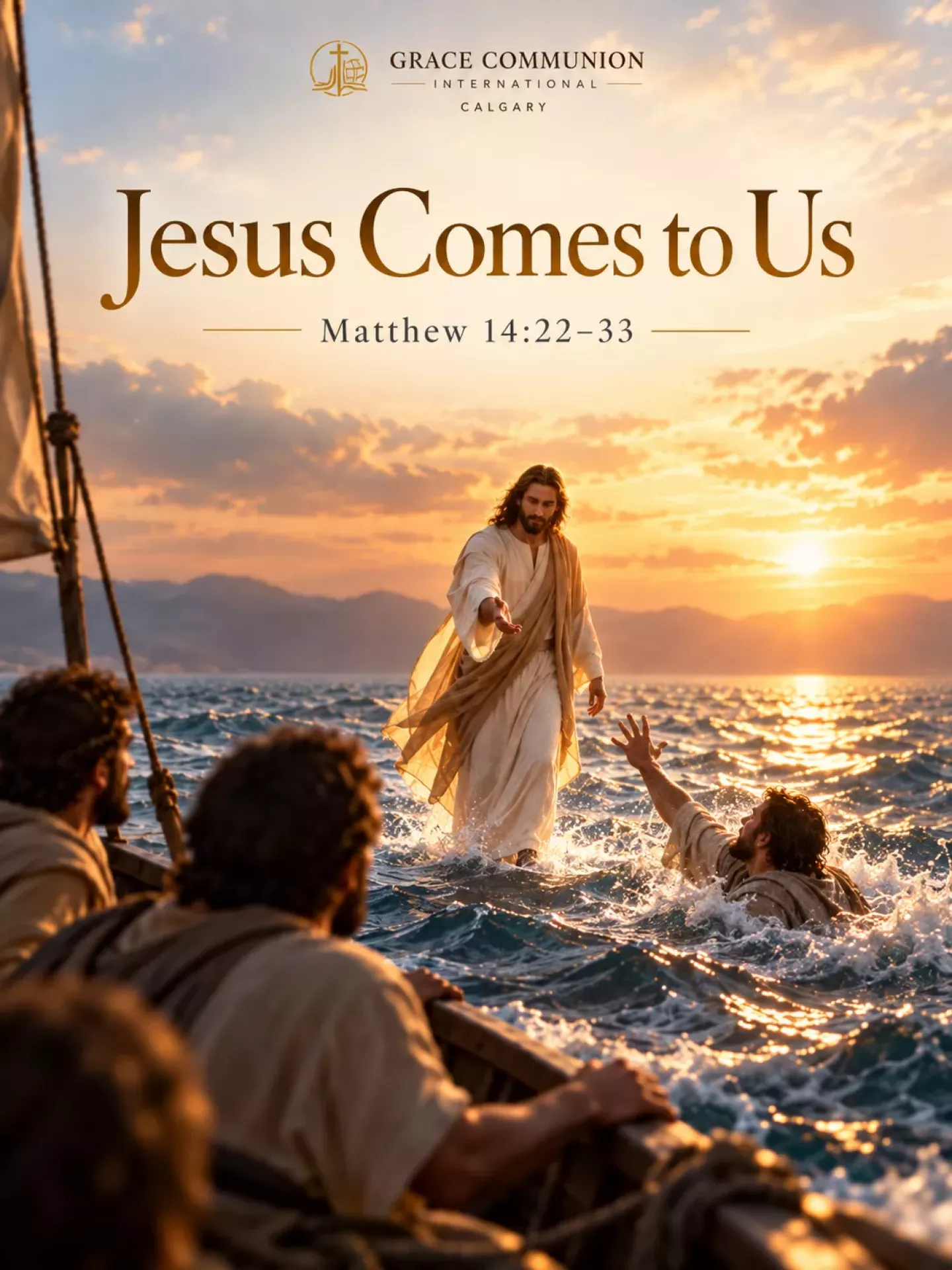
Matthew 14:22–33
Introduction
There are moments in life when everything seems calm. The direction is clear, the circumstances are manageable, and we feel confident about where we are going. Then suddenly, the wind changes.
A phone call comes. A relationship becomes strained. A financial problem develops. A door unexpectedly closes. A family enters a season of uncertainty. Something we thought was secure begins to shake.
Life has a way of bringing storms that we did not schedule and cannot control.
Matthew 14:22–33 brings us directly into such a moment. Jesus had just fed more than 5,000 people with five loaves and two fish. It had been a day of extraordinary blessing and supernatural provision.
Then Jesus instructed His disciples to get into a boat and go ahead of Him to the other side of the Sea of Galilee. The disciples obeyed.
Yet while they were doing exactly what Jesus told them to do, they encountered a storm.
Sometimes we assume that if we follow Christ faithfully, everything should become easier. But Scripture never makes that promise.
Sometimes obedience leads us directly into circumstances where our faith will be tested. The disciples were where Jesus told them to be, but the wind was still against them.
Maybe someone listening today knows what that feels like. You have prayed, but the wind is still against you. You have tried to remain faithful, but the wind is still against you. You have obeyed God as best you know how, but the waves have not stopped.
This passage teaches us not how to survive a storm. It teaches us who Jesus is in the storm. The greater revelation is that Jesus walked through the very thing that terrified the disciples in order to reach them.
The waves could not stop Him. The wind could not delay Him. The darkness could not hide His disciples from Him. And the distance between Jesus and the boat could not prevent Him from coming to them.
That leads us to our first truth.
1. Jesus Sees Us in the Storm
Matthew 14:22–27
Jesus sent the disciples ahead while He dismissed the crowd and went up on a mountainside to pray. Meanwhile, the disciples were struggling on the lake. They were far from shore. It was dark. The waves were pounding the boat. The wind was against them.
From the disciples’ perspective, Jesus seemed absent. But absence from their sight did not mean absence from their situation. Jesus knew exactly where they were.
This is one of the hardest lessons to learn during difficult seasons. When we cannot see what God is doing, we can easily conclude that God is doing nothing. When our prayers seem unanswered, we wonder, “Lord, where are You?” When circumstances do not change, we wonder whether God has forgotten us.
But Jesus had not forgotten the disciples.
Matthew 14:25
“Shortly before dawn Jesus went out to them, walking on the lake.”
Jesus went out to them. They could not get to Jesus, so Jesus came to them. They could not overcome the waves, but the waves could not overcome Jesus. The storm that was over their heads was already under His feet.
When the disciples saw Him, they were terrified because they thought He was a ghost. But Jesus immediately spoke:
“Take courage! It is I. Don’t be afraid.”
— Matthew 14:27
Before Jesus changed their circumstances, He gave them His presence.
Sometimes we want Jesus to say, “I will stop the storm.” Instead, He first says, “Take courage! It is I.” The presence of Christ is greater than the absence of trouble.
Psalm 46:1
“God is our refuge and strength, an ever-present help in trouble.”
Notice that Scripture does not say God is merely present after trouble. He is an ever-present help in trouble. God does not wait on the shore shouting instructions while we struggle in the waves. He is present with His people in their trouble.
Isaiah 43:2
“When you pass through the waters, I will be with you; and when you pass through the rivers, they will not sweep over you. When you walk through the fire, you will not be burned; the flames will not set you ablaze.”
Isaiah 43:2 gives another beautiful promise. God says that when His people pass through waters, He will be with them, and when they pass through rivers, those waters will not overwhelm them.
Notice the word “when.” Not if you pass through the waters. When.
God never promises that His children will never encounter deep waters. His promise is greater:
“I will be with you.”
Illustration
Imagine a small child waking during the night because of a thunderstorm. Lightning flashes. Thunder shakes the windows. The child becomes frightened and calls, “Dad! Mom!”
A parent enters the room. Interestingly, the storm has not stopped. The thunder is still loud. The lightning is still flashing. But something has changed. The child is no longer alone. The presence of someone the child trusts changes how the child experiences the storm.
The same is true spiritually. Sometimes Jesus calms the storm around us. Sometimes He first calms the fear within us by reminding us:
“It is I. Don’t be afraid.”
Church, if you are in a storm today, remember: Jesus sees you. You may not see Him yet. You may not understand what He is doing. But you have not disappeared from His sight.
2. Trust Jesus in the Storm
Matthew 14:28–31
Peter responds to Jesus:
“Lord, if it’s you,” Peter replied, “tell me to come to you on the water.”
Jesus gives Peter one simple command:
“Come.”
Peter steps out of the boat. For a moment, something extraordinary happens. Peter walks on water toward Jesus.
Think about this carefully. The storm had not stopped. The waves had not disappeared. The wind was still blowing. Yet Peter was walking toward Jesus.
This teaches us that faith does not require perfect circumstances. Faith requires a trustworthy Christ.
Peter’s confidence was not in the water. It was not in his ability. It was not in the weather. His confidence was in the One who said, “Come.”
But then something changed.
Matthew 14:30
“But when he saw the wind, he was afraid and, beginning to sink, cried out, ‘Lord, save me!’”
Peter moved his attention from Christ to the circumstances. The wind had already been blowing when Peter stepped out of the boat. The waves were already there when Peter started walking.
What changed was not primarily the storm. What changed was Peter’s focus.
As long as his attention was directed toward Jesus, he moved forward. When his attention became dominated by the wind, fear overwhelmed his faith.
How often does this happen to us? We begin trusting God. Then we look at the size of the problem. We look at the financial numbers. We look at what people are saying. We imagine everything that could go wrong. Suddenly, the storm looks bigger than the Savior.
Proverbs 3:5–6
“Trust in the Lord with all your heart and lean not on your own understanding; in all your ways submit to Him, and He will make your paths straight.”
Faith does not mean that we understand everything. Faith means that we know whom we are trusting even when we do not understand everything.
You may not understand why God allowed the storm. You may not know when it will end. You may not know what tomorrow will bring. But you can still trust the character of the One who called you.
Hebrews 12:2
“Fixing our eyes on Jesus, the pioneer and perfecter of faith. For the joy set before Him He endured the cross, scorning its shame, and sat down at the right hand of the throne of God.”
Hebrews 12:2 calls believers to keep their eyes fixed on Jesus. That is exactly what Peter needed.
Keep your eyes on Jesus.
The storm will compete for your attention. Fear will compete for your attention. Problems will compete for your attention. But faith says:
“I see the storm, but I will keep looking to Christ.”
When Peter began sinking, he prayed one of the shortest prayers in Scripture:
“Lord, save me!”
He did not have time for an elaborate prayer. He did not have time to explain his theology. He simply cried out.
Matthew 14:31 says:
“Immediately Jesus reached out His hand and caught him.”
Immediately.
Peter’s weak faith did not produce a weak Savior. Peter failed, but Jesus did not abandon him.
Illustration
Imagine walking across a narrow suspension bridge high above a valley. The bridge moves slightly beneath your feet. If you constantly stare downward at the enormous distance below, every movement becomes terrifying. Your legs become weak. Your mind begins imagining what could happen.
But an experienced guide walking ahead says:
“Look at me. Keep coming.”
The bridge has not changed. The height has not changed. But your point of focus has changed.
Many believers spend too much time staring at the valley beneath them instead of looking at the Savior before them.
Jesus does not tell us to pretend that the storm does not exist. He tells us that the storm does not deserve the final word.
When Jesus says, “Come,” we can trust Him. And if we begin to sink, we can still cry, “Lord, save me!” His hand is stronger than our weakness.
3. Jesus Reveals Who He Is
Matthew 14:32–33
Matthew tells us:
“And when they climbed into the boat, the wind died down.”
Then something even more important happens:
“Then those who were in the boat worshiped Him, saying, ‘Truly You are the Son of God.’”
The storm ended in worship.
Before the storm, the disciples knew Jesus. But after the storm, they understood something about Him more deeply. They had seen Jesus multiply bread. Now they saw that even creation itself was under His authority.
They watched Jesus walk on what threatened to destroy them. They watched Him rescue Peter. They watched the wind become still when He entered the boat.
Their response was:
“Truly You are the Son of God.”
Sometimes God uses storms to reveal dimensions of His character that we would never discover on calm water.
We learn that He is Provider when we experience need. We learn that He is Comforter when we experience sorrow. We learn that He is our Strength when our own strength fails. We learn that He is faithful when everything around us feels uncertain. We learn that He is Lord when circumstances move beyond our control.
Romans 8:28
“And we know that in all things God works for the good of those who love Him, who have been called according to His purpose.”
The verse does not say all things are good. Storms are painful. Loss is painful. Disappointment is painful.
But God is so sovereign that He can work in all things for His purposes. The storm may not be good, but God can work through the storm.
James 1:2–4
“Consider it pure joy, my brothers and sisters, whenever you face trials of many kinds, because you know that the testing of your faith produces perseverance. Let perseverance finish its work so that you may be mature and complete, not lacking anything.”
James teaches believers to consider trials with joy because the testing of faith produces perseverance, and perseverance matures God’s people.
Trials can become spiritual classrooms. There are things we learn about God in storms that we rarely learn on calm seas.
The disciples entered the boat knowing Jesus as their Teacher. They came through the storm worshiping Him as the Son of God.
Illustration
Imagine a sculptor working with a rough block of stone. To someone unfamiliar with the process, what the sculptor does may look destructive. The hammer strikes. Pieces fall away. The chisel cuts into the stone.
If the stone could speak, perhaps it would ask:
“Why are you hitting me?”
But the sculptor sees something the observer cannot yet see. He sees what the stone is becoming. The hammer is not random. The chisel is not uncontrolled. Every strike is part of the sculptor’s purpose.
In the same way, we sometimes see only the painful moment. God sees what He is forming within us.
The storm may be shaping perseverance. It may be deepening prayer. It may be exposing something we have trusted more than God. It may be teaching us dependence. It may be preparing us to encourage someone else.
Sometimes the purpose becomes clear only afterward. We entered the storm asking, “Lord, why?” But we may leave the storm saying:
“Truly You are the Son of God.”
Conclusion
Let us return to the boat.
It is dark. The disciples are tired. The wind is against them. The waves are pounding the boat. They cannot see a solution.
Then, somewhere across the water, Someone is approaching. At first, they cannot recognize Him. They are afraid. But then they hear a familiar voice:
“Take courage! It is I. Don’t be afraid.”
Church, that is the heart of this passage. Jesus comes to His people in the storm.
The storm does not mean He has forgotten you. The darkness does not mean He cannot see you. The delay does not mean He does not care. The waves do not mean He has lost control.
The same water threatening the disciples was under the feet of Jesus.
What is over your head is still under His authority.
Perhaps your storm today is in your family. Perhaps it concerns your future. Perhaps you are carrying financial uncertainty. Perhaps you are facing disappointment. Perhaps you have been praying for something for a long time and nothing seems to be changing.
Perhaps everyone around you thinks you are doing fine, but inside you feel like Peter:
“I’m sinking.”
Then Peter’s prayer can become your prayer:
“Lord, save me!”
Notice again what Jesus did: He reached out His hand.
Peter did not rescue himself. Peter did not swim back to the boat. Jesus caught him.
That is the gospel.
Humanity was sinking under sin and could not rescue itself. So Jesus came to us. The Son of God entered our broken world. He went to the cross. He carried our sin. He died in our place. He rose again.
Salvation is found not in our ability to save ourselves, but in reaching by faith toward the Savior who has already come to rescue us.
There may be three kinds of people listening today.
Some are entering a storm. If that is you, remember: Jesus already knows what is ahead.
Some are in the middle of a storm. If that is you, remember: Jesus sees you and is able to come to you.
Others are coming out of a storm. If that is you, do what the disciples did: worship Him. Tell somebody what God has done. Let your testimony say:
“I went through something I thought would destroy me, but Jesus met me there.”
The goal is not simply to reach the other side. The goal is to reach the other side knowing Jesus more deeply than we did before the storm.
When the wind blows, remember: Jesus sees you in the storm.
When fear tells you to give up, remember: Jesus calls you to trust Him in the storm.
When you cannot understand why God has allowed the journey to become so difficult, remember: Jesus can reveal His glory through the storm.
Brothers and sisters, when you cannot see the shore, look to Jesus. When you cannot understand the circumstances, trust Jesus. When fear begins to overwhelm you, call on Jesus. When He reaches out His hand, take hold by faith. And when He brings you through, worship Jesus.
The One who comes walking toward us in the storm is no ordinary man. He is the One before whom winds and waves must bow.
He is our Savior. He is our Lord.
And with the disciples we declare:
“Truly You are the Son of God.”




Comments
Thank you for sharing.